> For the complete documentation index, see [llms.txt](https://docs.pentaho.com/llms.txt). Markdown versions of documentation pages are available by appending `.md` to page URLs; this page is available as [Markdown](https://docs.pentaho.com/whats-new/readme.md).
# What's New in 11.0
Release 11 of Pentaho Data Integration & Analytics includes several major updates that improve the user experience in both Data Integration and Business Analytics. It also introduces new performance- and security-related features, as well as simplified deployment and upgrades.
Release 11 is a Long Term Supported (LTS) release. For details about the support period and the service pack and update release schedule, see the[ Pentaho Support Lifecycle page](https://support.pentaho.com/hc/en-us/articles/205789159-Pentaho-Product-Lifecycle-Overview).
The **key features and enhancements introduced** in this release are:
1. [**Pipeline Designer**](#pipeline-designer)
2. [**Project Lifecycle Management**](#project-lifecycle-management)
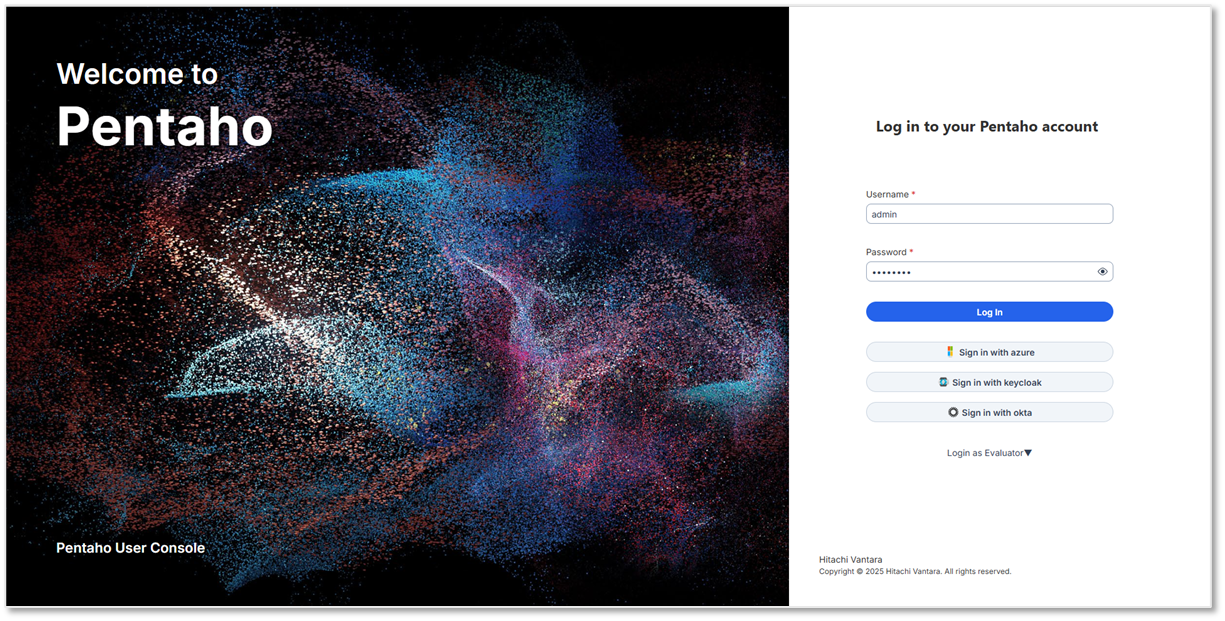
3. [**New Pentaho User Console**](#new-pentaho-user-console-preview) **(Preview)**
4. [**New Data Modeling Workflow (replacing Schema Workbench and Data Source Wizard)**](#new-data-modeling-workflow)
5. [**Out-of-the-box support for OIDC / OAuth 2.0**](#out-of-the-box-support-for-oidc-oauth-2.0)
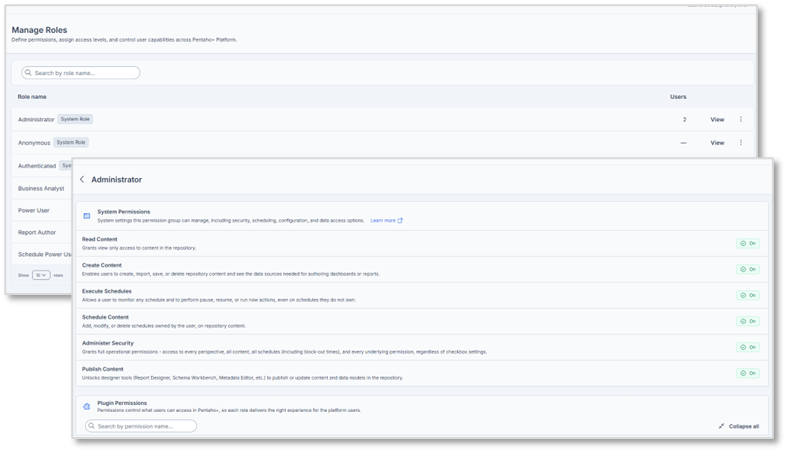
6. [**Granular Permissions in Pentaho / BA Server**](#granular-permissions-for-pentaho-ba-server)
7. [**Docker Simplification**](#docker-simplification)
8. [**Java 21 Support & Tomcat 10**](#java-21-support-tomcat-10)
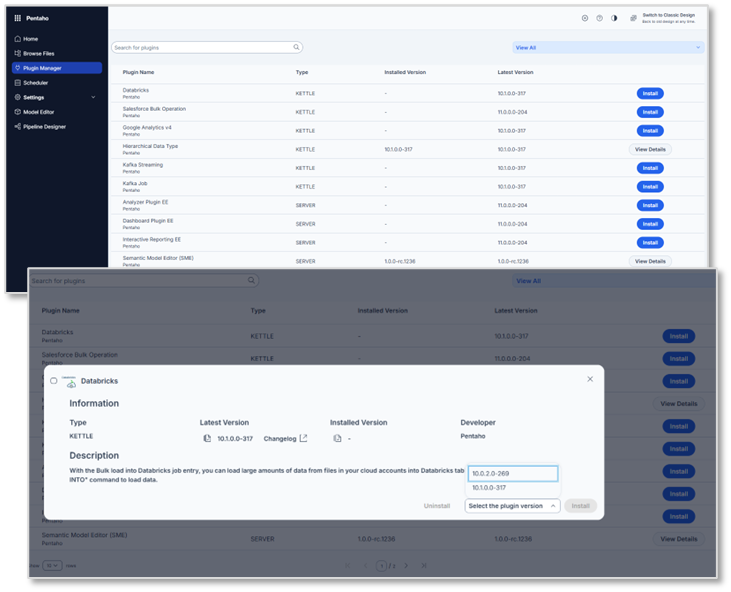
9. [**Plugin Manager**](#plugin-manager)
10. [**Karaf/OSGi removal and Big Data plugins**](#karaf-osgi-removal-and-big-data-plugins)
11. [**OTEL-based observability**](#otel-based-observability)
The following sections describe each of these features and enhancements.
## Pipeline Designer
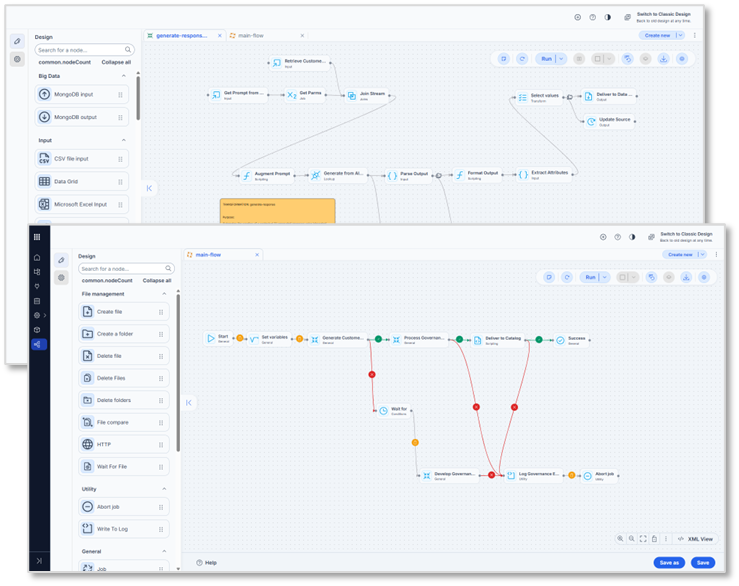
Release 11 introduces a browser-based user experience (UX) that you can use to author ETL pipelines. This experience enables you to build PDI transformations and jobs in a web browser without the need to deploy Spoon.
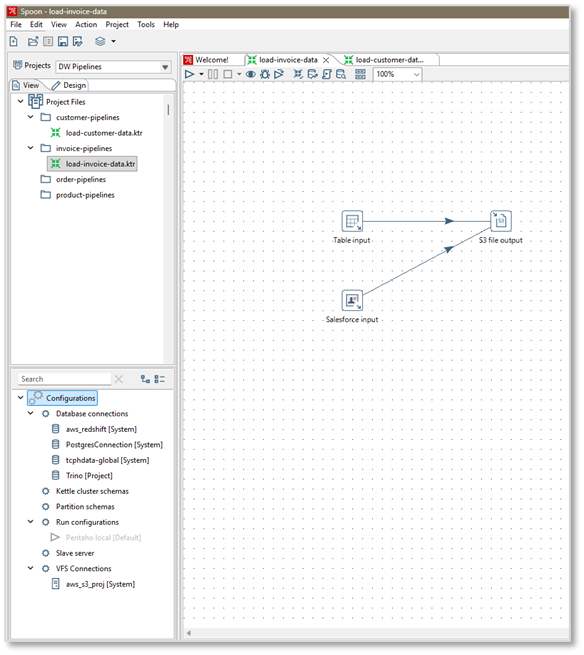
Conceptually, it is similar to the Spoon interface that users know and rely on. However, the UI is built on a modern UI framework. This interface also maintains compatibility with existing transformations and jobs that you developed by using Spoon.
For more information, see [Pipeline Designer](/pba/pipeline-designer.md).
## Project Lifecycle Management
In PDI versions prior to Release 11, there was no defined structure for organizing transformations, jobs, and associated configuration. This lack of structure made it challenging for ETL developers and DevOps teams to keep pipeline development work organized and made collaboration and migration across environments difficult.
In addition, there were differences in how configuration references were resolved, resulting in behavior that might appear to be inconsistent.
Project Lifecycle Management introduces several features to address these gaps. For more information, see [Configuring ETL with Projects](https://docs.pentaho.com/pdia-data-integration/pdia-11.0-data-integration/organizing-etl-with-projects#manageability).
## New Pentaho User Console (Preview)
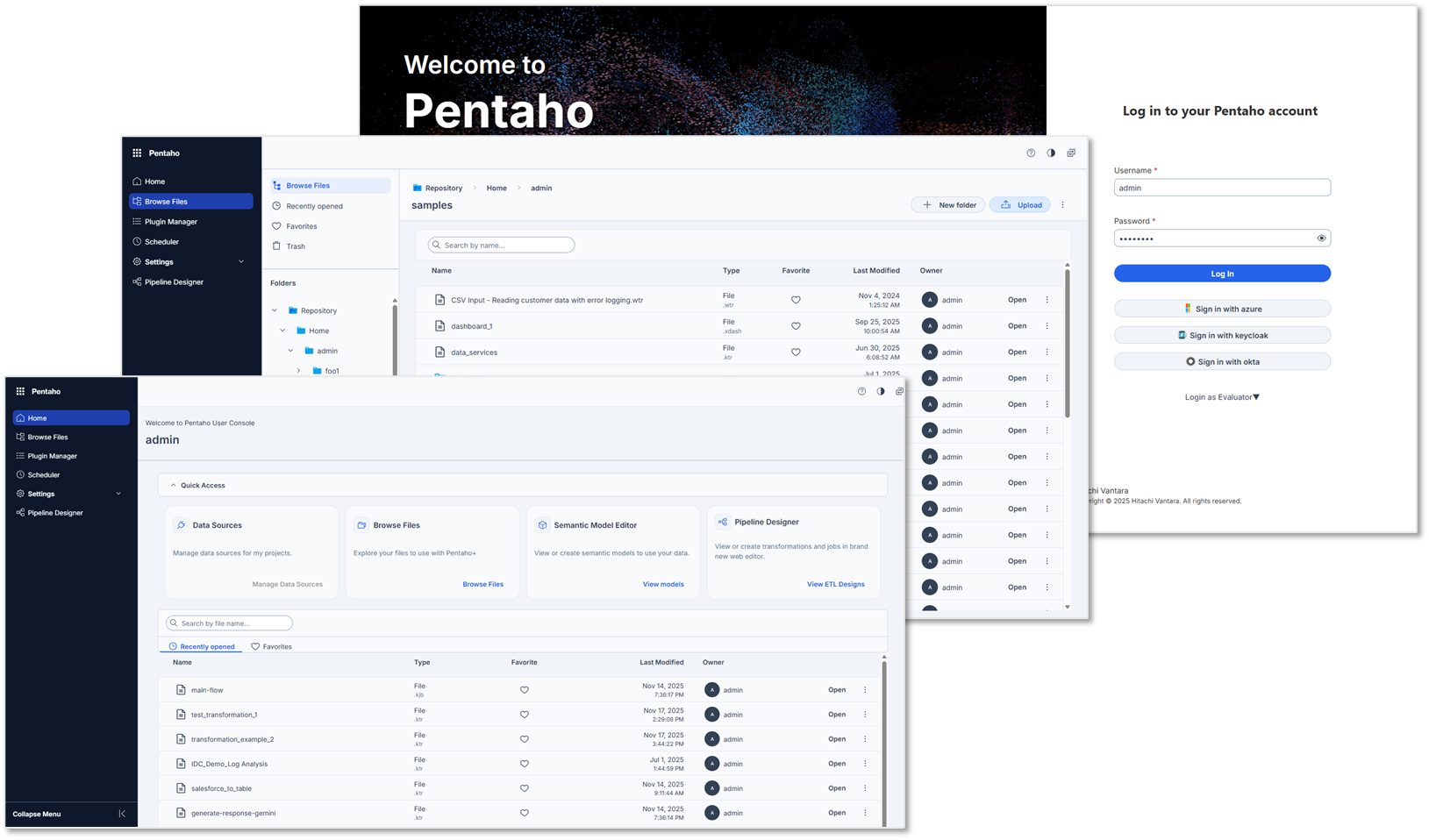
With Release 11, Pentaho introduces a completely revamped user experience (UX) for Pentaho User Console (PUC). This UX aligns with the broader Pentaho platform UX and serves as the entry point for most PDI and PBA users. The new UX presents a more modern and convenient interface and addresses several pain points associated with the existing PUC in 10.2 and earlier.
The existing PUC will continue to be available until all existing functionality has been moved to the new UX. For more information, see [Introducing Modern PUC](https://docs.pentaho.com/pba/11.0-pba/pentaho-user-console/modern-design).
## New Data Modeling Workflow
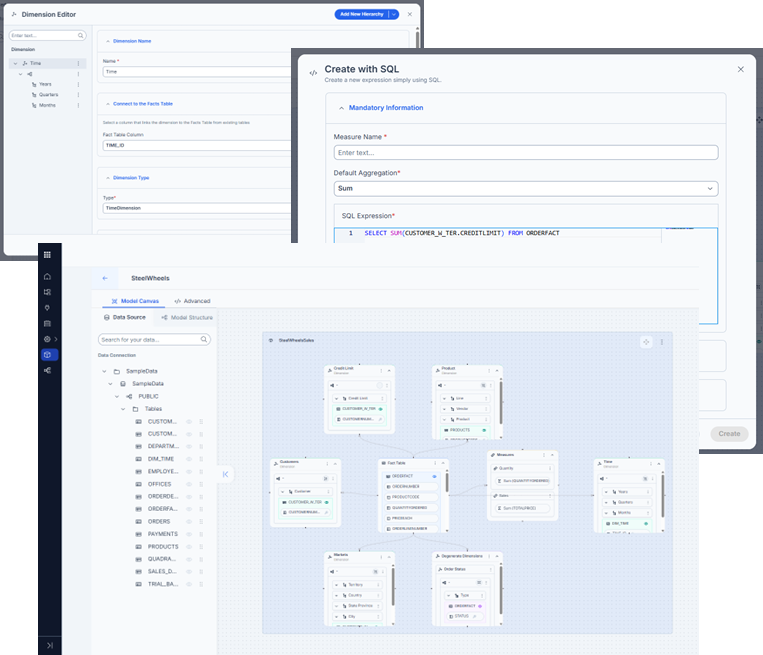
Release 11 introduces a new tool for building and managing Mondrian data models. Customers have typically used Schema Workbench or Data Source Wizard to build, edit, and deploy Mondrian models. Pentaho now includes a web-based tool, Semantic Model Editor (SME), that enables you to build and manage Mondrian models in an easy-to-use, modern UX.
Both novice and advanced users can use SME to work with Mondrian data models. SME provides a significantly better experience for users of PBA and especially Analyzer. In addition, SME supports all existing Mondrian models and provides advanced capabilities that were not available in either Schema Workbench or Data Source Wizard.
For more information, see [Semantic Model Editor](https://docs.pentaho.com/pba/11.0-pba/semantic-model-editor).
## Out-of-the-box support for OIDC / OAuth 2.0
Release 11 supports OAuth 2.0/OIDC authentication for Pentaho Server, enabling single sign-on (SSO) integration with identity providers such as Google, Okta, and Azure. It supports any OIDC-compliant identity provider (IdP). This support greatly simplifies SSO configuration in Pentaho.
For more information, see [OIDC/OAuth](/pdia-admin/secure-the-pentaho-system/user-security/advanced-security-providers/oidc-oauth-2.0.md).
## Granular Permissions for Pentaho / BA Server
Release 11 introduces more granular and flexible access control across the platform to address several long-standing challenges, such as:
1. Permissions were not sufficiently fine-grained. For example, the "Read Content" permission allows a user to see any content from any plugin (unless file or folder permissions prevent it).
2. Permissions were not structured in a way that could prevent or provide access to individual plugins.
3. Permissions were not sufficiently fine-grained for data sources or other assets.
4. Execute permissions were very broad.
Release 11 addresses these issues in Pentaho Server. Together with OAuth 2.0/OIDC support, Pentaho now has a more robust authentication and authorization model.
For more information, see [Granular Permissions for Pentaho](https://docs.pentaho.com/pba/11.0-pba/semantic-model-editor/sharing-a-semantic-model/permissions-for-semantic-models).
## Docker Simplification
Release 11 significantly simplifies Docker-based Pentaho deployments. First, Pentaho introduces optimized, prebuilt images for on-premises deployments (plain Docker and Kubernetes \[K8s]), EKS, AKS, and GKE. These images have standardized installation paths and variables. In addition, enhanced entrypoint scripts support runtime configuration overrides (configuration files and licenses), allowing flexible customization by injecting files at startup.
For more information, see [Docker Deployment](https://docs.pentaho.com/install/pentaho-installation-overview-cp/docker-container-deployment-of-pentaho-server).
## Java 21 Support & Tomcat 10
Java 21 is supported in Release 11. This support allows customers to operate Pentaho with an Oracle JVM without associated licensing costs. Customers can continue to use OpenJDK or other supported JVMs (see the list of supported JVMs in the documentation).
Pentaho Server in Release 11 comes with Tomcat 10, addressing several vulnerabilities and other defects associated with Tomcat 9.
For more information about supported JVM and Tomcat versions, see [Components Reference](https://docs.pentaho.com/install/pdia-11.0-installation/components-reference).
## Plugin Manager
Release 11 introduces a Plugin Manager that enables administrators to manage both PDI and PBA plugins. Going forward, Pentaho will release new functionality as plugins where possible. Having a plugin manager to identify, deploy, and manage plugins conveniently is therefore key to managing Pentaho deployments.
For more information, see [Plugin Manager](https://docs.pentaho.com/pba/11.0-pba/pentaho-user-console/modern-design/plugin-manager).
## Karaf / OSGi Removal and Big Data Plugins
With Release 11, Karaf and OSGi are completely removed from PDI. Big data components are now available as plugins. There is no separate PDI deployment with big data add-ons. Big data components are treated the same as any other PDI plugin and can be deployed in the same manner.
This change significantly reduces the size of both the PDI client and Pentaho Server deployments by more than 1 GB.
For more information, see [Plugin Manager](https://docs.pentaho.com/pba/11.0-pba/pentaho-user-console/modern-design/plugin-manager).
## OTEL-based Observability
[OTEL](https://opentelemetry.io/docs/languages/java/) is an open standard for applications to communicate telemetry data, such as traces, metrics, and logs. There is a broad ecosystem of tools that can consume OTEL data, including Datadog, Splunk, Elastic, Amazon CloudWatch, and Azure Monitor.
With the OTEL plugin, you can monitor every Pentaho ETL process with the following:
* Logs that are consolidated in a single place and represented hierarchically
* Traces to view task timing, execution hierarchy, and variables during execution
* Metrics to track data flow trends at specified points of interest
For more information, see [Plugin Manager](https://docs.pentaho.com/pba/11.0-pba/pentaho-user-console/modern-design/plugin-manager).
## Other Enhancements
Release 11 also introduces several other enhancements and defect fixes. These are documented in the release notes.
---
# Agent Instructions
This documentation is published with GitBook. GitBook is the documentation platform designed so that both humans and AI agents can read, navigate, and reason over technical content effectively. Learn more at gitbook.com.
## Querying This Documentation
If you need additional information that is not directly available in this page, you can query the documentation dynamically by asking a question.
Perform an HTTP GET request on the current page URL with the `ask` query parameter, and the optional `goal` query parameter:
```
GET https://docs.pentaho.com/whats-new/readme.md?ask=&goal=
```
`ask` is the immediate question: it should be specific, self-contained, and written in natural language.
`goal` is optional and describes the broader end goal you are ultimately trying to accomplish on behalf of the user. GitBook uses it to tailor the answer towards what is most useful for that goal.
The response will contain a direct answer to the question and relevant excerpts and sources from the documentation.
Use this mechanism when the answer is not explicitly present in the current page, you need clarification or additional context, or you want to retrieve related documentation sections.